Languages
Serving European and Brazilian Portuguese speakers: the differences customers notice
Learn the key vocabulary, grammar, and tone differences between European and Brazilian Portuguese to provide better customer service for your online store.
Ralfi4 min read
# Selling in Portuguese to Portugal and Brazil
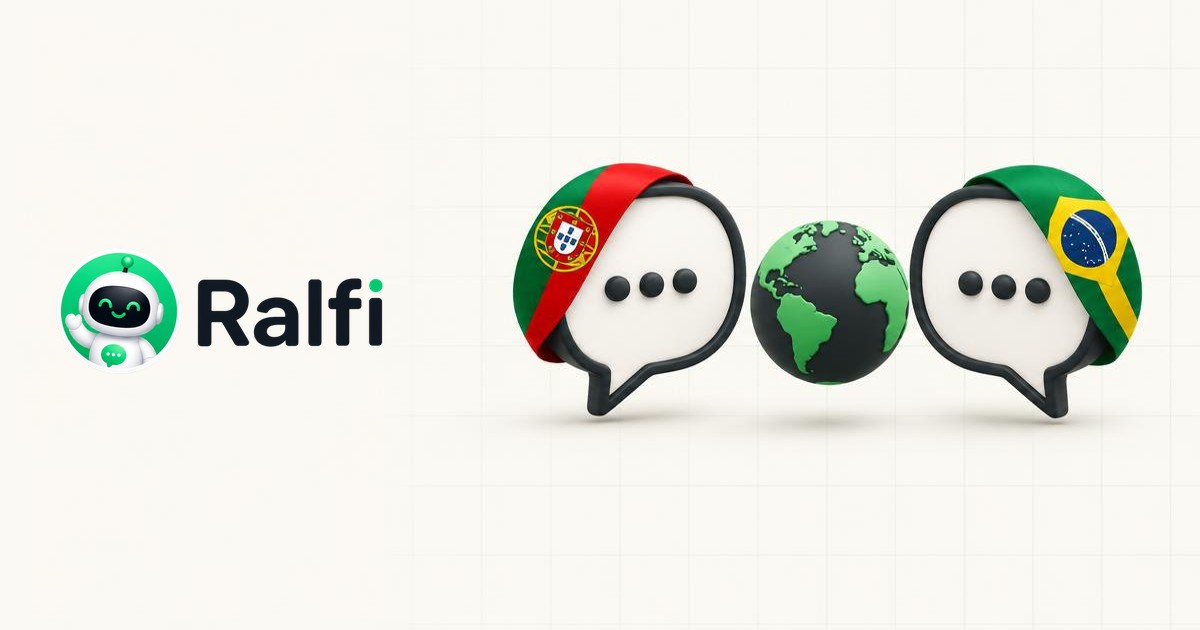
If you sell to both Portugal and Brazil, you know the language is not the same. The words are different. The way you talk to customers is different.
Using the wrong words can make your store seem foreign. It can confuse people and stop a sale. Getting this right is part of good service.
Different words for your store
Using the wrong word can confuse a customer and stop a sale. For example, a customer in Brazil searches for a `maiô`. Your store is based in Portugal and lists it as a `fato de banho`. The customer will not find your product.
Your search results are also affected. People cannot find your items if you don't use their local words.
Here are some common words in online stores:
- Order: `Encomenda` (PT) vs. `Pedido` (BR).
- Address: `Morada` (PT) vs. `Endereço` (BR).
- Mobile phone: `Telemóvel` (PT) vs. `Celular` (BR).
- Registration: `Registo` (PT) vs. `Cadastro` (BR).
- Jumper / Sweater: `Camisola` (PT) vs. `Suéter` / `Blusa de frio` (BR). In Brazil, `camisola` is a nightgown.
You should change your product descriptions and website text for your main customers. If you sell to both countries, think about having a separate website for each one.
How you speak to your customers
The way you say 'you' is important. In Portugal, it can be complicated.
- In Portugal: `Você` is formal. You use it with older people or people you don't know. To be more formal, some shops talk about the customer in the third person, like “The customer can...”. `Tu` is only for friends. Using `você` is a safe option for your store.
- In Brazil: `Você` is the normal word for 'you'. You can use it in formal and informal situations. It is the best choice for business.
The general tone is also different. Talk in Brazil is often warmer. People might say “Oi, tudo bem? Em que posso te ajudar?” (“Hi, how are you? How can I help you?”). In Portugal, it is more direct. For example, “Bom dia. Em que posso ser útil?” (“Good morning. How can I be useful?”). Customers expect the style they know.
Small grammar points
Small grammar differences show if a text is from Portugal or Brazil. Getting them right shows you pay attention.
One common difference is the present continuous.
- PT-PT: “Estou a processar a sua encomenda.” (I am processing your order.)
- PT-BR: “Estou processando seu pedido.” (I am processing your order.)
Another is where to put object pronouns. Portugal tends to put them after the verb. Brazil puts them before.
- PT-PT: “Diga-me se precisar de ajuda.” (Tell me if you need help.)
- PT-BR: “Me diga se precisar de ajuda.” (Tell me if you need help.)
Native speakers notice these things. If you are consistent, your store looks more professional.
Practical steps for your store
These language differences affect how you run your store.
- Website and SEO. If you sell a lot to both markets, you may need two site versions. You could use `yourstore.com/pt-pt` and `yourstore.com/pt-br`. Use the `hreflang` tag to tell search engines which one to show.
- Customer service. This is a key area. Your team and any chatbots should talk to customers in their own version of Portuguese. Using the wrong one can look unprofessional.
- Marketing. Localise your email campaigns, social media, and ads. For example, a wine shop in Portugal could talk about the `casta` (grape variety) and `região demarcada` (demarcated region). In Brazil, it might be better to mention `harmonização` (food pairing) or the `experiência` (experience) of sharing the wine.
Speaking your customer's language
When you use the right words for customers in Portugal and Brazil, it shows you respect them. You look more professional and treat them as separate markets. This helps build trust with customers, which can lead to more sales.
An AI sales assistant can help you do this for every customer. Ralfi, for example, is made to communicate in both European and Brazilian Portuguese. This means every customer conversation uses the correct local language.